
|
CAMBODIA: S-21 | Phnom Penh | Angkor Wat | Bayon | Ta Prohm |
|
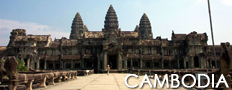
Cambodia Jungle Wat (Ta Prohm) Photos
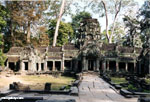
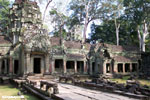
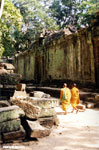
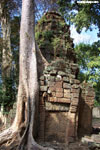
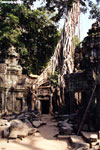
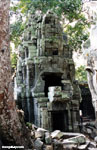
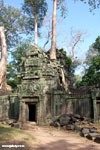
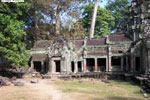
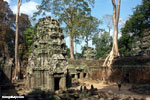
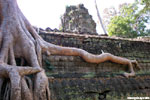
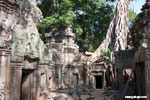
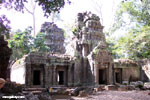
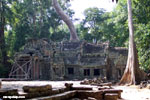
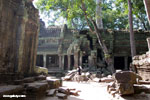
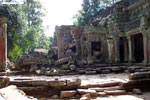
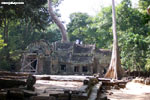
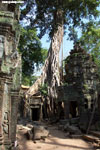
Jungle Wat (Ta Prohm) All images are the property of Rhett Butler, copyright 2003. Contact me regarding use and reproduction. Angkor of Cambodia was the heart of the Khmer Empire for about 550 years (9th to 15th centuries) before overpopulation and environmental degradation lead to its abandonment. At its peak, the city spawled over an area the size of Los Angeles and supported more than a million people. These pictures show Ta Prohm, a buddhist monastic complex where some of the original vegetation has been left uncleared by archaeologists. There are two pages of images from Ta Prohm: Jungle Wat (Ta Prohm) and Doors & wall sculptures
Recommended travel guides on Cambodia: 
Ta Prohm - from Wikipedia Ta Prohm is a temple at Angkor, Cambodia, built in the Bayon style largely in the late 12th and early 13th centuries. Located approximately one kilometre east of Angkor Thom and on the southern edge of the East Baray, it was built by King Jayavarman VII as a Mahayana Buddhist monastery and university. Unlike most of the other Angkor temples, Ta Prohm has been left in much the same condition in which it was found: the photogenic and atmospheric combination of trees growing out of the ruins and the jungle surroundings have made it one of Angkor's most popular temples with visitors History Ta Prohm was one of the first temples begun in Jayavarman VII's massive building program. The temple's modern name means "old Brahma", but the original name was Rajavihara (royal temple). It was centred on veneration of the king's family: the main image (of Prajnaparamita, the personification of wisdom, installed in 1186) was modelled on his mother, while the two satellite temples in the third enclosure were dedicated to his guru (north) and his elder brother (south). Expansions and additions continued as late as the rule of Srindravarman at the end of the 13th century. The temple's stele recorded that the site was home to more than 12,500 people, with a further 80,000 in surrounding villages helping to supply the institution. The temple amassed considerable riches, including gold, pearls and silks. After the fall of the Khmer empire, the temple fell into neglect for centuries. When the effort to conserve and restore the temples of Angkor began in the early 20th century, Ta Prohm was chosen by the �cole Fran�aise d'Extr�me-Orient to be left largely as it was found as a "concession to the general taste for the picturesque" (Glaize). Glaize writes that this temple was chosen because it was, "one of the most imposing and the one which had best merged with the jungle, but not yet to the point of becoming a part of it - as but one specimen typical of a form of Khmer art of which there were already other models". Nevertheless much work has been done to stabilise the ruins and to permit access, in order to maintain "this condition of apparent neglect" (Freeman and Jacques). continued >> |

what's new | rainforests | tropical fish | for kids | search | about | copyright & use | contact |
Copyright Rhett Butler 1994-2025 Pictures were taken by Rhett A. Butler, copyright 1994-2025. While these photos are the property of mongabay.com, it may be permissible to use them for non-commercial purposes (like powerpoint presentations and school projects), provided that the images are not altered in any form. Please read this for more details. If you are interested in using an image in a publication please contact me. Mongabay.com is a free resource. |