VENEZUELA: Angel Falls | Tepuis | Tepui Summit | Water | Fauna | Flora
Home
News
About
Travel Photos
  Argentina
  Australia
  Belize
  Bhutan
  Botswana
  Brazil
  Burma
  Cambodia
  China
  Colombia
  Costa Rica
  Croatia
  Ecuador
  Gabon
  Grand Canyon
  Guatemala
  Honduras
  Iceland
  India
  Indonesia
  Italy
  Jordan
  Kenya
  Laos
  Madagascar
  Malaysia
  Mexico
  Panama
  Peru
  Nepal
  New Zealand
  Slovenia
  Suriname
  Tanzania
  Thailand
  Uganda
  United States
  Venezuela
High resolution
Slideshows
Photos by topic
  Birds
  Coral reefs
  Deforestation
  Frogs
  Glaciers
  Insects
  Lemurs
  Mammals
  Monkeys
  Rainforests
  Reptiles
  Sunsets
  Wildlife
  Top 10
  MORE
Rainforests
For kids
Tropical Fish
Rainforest Tips
Languages
Books
T-shirts
Calendars
Newsletter
Copyright
Contact


Venezuela Pictures

During the summer of 1996 I went trekking on and around Auyentepui in Venezuela.


SECTIONS:

Angel Falls

Flora

Fauna

Tepui Summit

Rivers & Creeks

Tepui & Scenery


HIGHLIGHTS:

Tabletop mountains (called tepui) as seen from the Rio Carrao


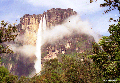
Angel falls seen from an airplane


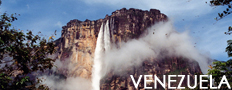
Angel falls, the world's tallest waterfall, seen from an airplane


Edge of an area deforested long ago by miners in Venezuela


Coloful bromeliad in southern Venezuela


Tank bromeliad in southern Venezuela


Garden of bromeliads on the approach to the tepui summit


Epiphyte garden near to the summit of Auyantepui


Pemón guide in an epiphyte garden near the summit of Auyantepui


Yellow-banded Poison Arrow Frog (Dendrobates leucomelas) in Venezuela


Angel falls, the world's highest waterfall


Yellow, black, orange, and white grasshopper in Venezuela


Heliconius butterfly on a hotlips flower


Tarantula in Venezuela


Fisherman with a catfish from the Rio Carrao


Emergent canopy tree with a tepui in the background


Former village site along the Carrao river in Venezuela


Pink sandstone of Auyantepui


Tepui in Venzuela, seen from the Carrao river


Auyantepui as seen from the Rio Carrao


Angel falls, the world's tallest waterfall, located in Venezuela


Summit of Auyantepui, Devil's mountain, Venezuela


Wei tepui in Venezuela


Devil's mountain (Auyan tepui) waterfall


Internal waterfall on the summit of Auyantepui


Crevasse on Devil's mountain


Blackwater creek on the trail to the Auyantepui summit


View up at the rainforest canopy in the Venezuelan Amazon


Angel falls as seen from its base


Recommended travel guides on Venezuela:


Venezuela -- from Wikipedia

Venezuela is home to a wide variety of landscapes, such as the northeasternmost extensions of the Andes mountains in the northwest and along the northern Caribbean coast, of which the highest point is the Pico Bolívar at 5,007 m.

Also found in the northwest are the lowlands around Lake Maracaibo and the Gulf of Venezuela. The centre of the country is characterised by extensive plains known as the llanos that stretch from the Colombian border to the river delta of the Orinoco east. To the south are found the dissected Guiana Highlands, home to Angel Falls, the world's highest waterfall.

The local climate is tropical and generally hot and humid, though more moderate in the highlands. The capital, Caracas is also the country's largest city. Other major cities include Maracaibo, Barquisimeto, Valencia, Maracay, and Ciudad Guayana. (more) History

Venezuela was the site of one of the first permanent Spanish settlements in South America in 1522, and most of the territory eventually became part of the viceroyalty of New Granada. Parts of what is now eastern Venezuela became New Andalusia. After several unsuccessful uprisings, the country declared independence from Spain in 1811 under the leadership of its most famous son, Simón Bolívar.The revolutionary war was decided, however, in the famous battle of Carabobo in June 24th 1821, led against Bolívar's orders by "Grand Marshall" (Gran Mariscal de Ayacucho) Antonio José de Sucre, when the revolutionaries beat the Spaniards. Simon Bolivar led the armies of Venezuela and other countries to free and found what are now Colombia, Panama, Ecuador, Peru, and Bolivia. Another important revolutionary leader during the war was the aforementioned Antonio José de Sucre, who won many battles for Bolivar and was a candidate to become his natural succesor until he was murdered. Venezuela became, after the revolutionary war, along with Colombia and Ecuador part of the Republic of Gran Colombia (República de Gran Colombia) until 1830, when the country separated and became a sovereign republic.

Much of Venezuela's 19th and early 20th century history was characterized by political instability, political struggle, and dictatorial rule. Following the death of Juan Vicente Gómez in 1935 and the demise of caudillismo (authoritarian oligarchical rule), democratic struggles eventually forced the military to withdraw from direct involvement in national politics in 1958. Since that year, Venezuela has enjoyed an unbroken tradition of democratic civilian rule, though not without conflict.

In 1992, there was an attempt by rebellious entities within the Venezuelan military, led by Lieutenant Hugo Chávez, to remove two-time democratically elected president Carlos Andrés Pérez from power. The coup ultimately failed, and Chávez and his co-conspirators were jailed for treason. Pérez, on the other hand, was eventually impeached and convicted for corruption. The coup brought about the death of 80 civilians and 17 members of the armed forces. Chávez's role in resisting a president generally perceived as corrupt by the lower classes made him a prominent figure among them. Chávez was eventually released from jail in 1994 by Perez's elected successor, Rafael Caldera.

Chávez was elected president in 1998 with 56% of the vote as part of a new political party, the Movement for the Fifth Republic. His platform ("Bolivarian revolution") called for the signing of a new constitution, which was written by a Constituent Assembly and approved by referendum in 1999. Chávez was re-elected in 2000 under the new constitution with 59% of the vote. In November 2000, the National Assembly granted Chávez the right to rule by decree for one year, and in November 2001, Chávez made a set of 49 decrees, including large reforms in oil and agrarian policy. The Chávez presidency has for the first time given the majority of Venezuelans a share in the national wealth.

Chavez controls all branches of the government since his party has a majority in the National Assembly, and he has hand picked the judges of the Supreme Tribunal.

In December 2001, the nation's largest business organizations and the petroleum workers' union organized a general strike. In 2002, the US-backed opposition staged an unsuccessful coup and briefly installed Pedro Carmona Estanga as president of Venezuela. Due to a subsequent, popular uprising, with support from the rank and file members of the military, Pedro Carmona was forced to resign. Diosdado Cabello, Vice President of Venezuela, became president as dictated by the constitution. Chávez was restored to the Presidency in 48 hours. A recall referendum was held on August 15, 2004, which Chávez won with approximately 58% of the vote. Leaders and supporters of the opposition accused Chavez of rigging the election, but failed to prove the accusation. The opposition claims were later silenced when the Organization of American States and the Carter Center certified the referendum. In 2004 plans for another coup were allegedly foiled.

Since then, Chávez's popularity in Venezuela and throughout Latin America, where two-thirds of the South American continent have elected pro-people presidencies, has grown. As oil prices have soared in the wake of the second Iraqi war and booming Chinese demand, oil-rich Venezuela has had the opportunity to refuse loans and aid from the US.

The Bush Administration's influence in Caracas has plummeted, as president Hugo Chávez accuses the Bush administration of supporting the failed 2002 Venezuelan coup. Chávez's program has sought to decrease dependency on Washington and to diversify diplomatic and economic ties with governments throughout the world, such as Cuba, Brazil, Argentina, Uruguay, among many other Latin American countries, as well as China, Iran and India. His government has also consistently pursued closer ties to other countries opposed to global control by the US corporate state.

Articles involving conservation and the environment in Venezuela:

New spiny pocket mouse discovered in the mountainous rainforests of Venezuela

(02/08/2010) Researchers have discovered a new species of spiny mouse that lives on four mountainous forests in the Cordillera de la Costa mountain range of Venezuela.


Copenhagen Climate Summit: Hugo Chávez is an Inappropriate Environmental Messenger

(12/17/2009) Like him or not, one thing is for sure: the flamboyant Hugo Chávez has never shied away from the limelight. I was therefore somewhat surprised to read some initial press accounts suggesting that the Venezuelan leader might stay away from the United Nations climate summit being held in Copenhagen, Denmark. "If it's to go and waste time, it’s better I don't go," he said. "If everything is already cooked up by the big [nations], then forget it." Chávez however hinted that he might change his mind if ALBA nations could reach some type of common position towards the Copenhagen summit. ALBA, an initiative designed to facilitate trade and reciprocity amongst like minded progressive regimes in Latin America, has taken up the issue of climate justice as of late. Two months ago Bolivian President and ALBA ally Evo Morales called for the creation of an actual climate justice tribunal. The Global North, Morales said, should indemnify poor nations for the ravages of climate change.


High gold prices, army collaboration, play role in mining invasion in southern Venezuela

(11/25/2009) Illegal gold mining involving wildcat miners, the Venezuelan army, and indigenous groups is threatening one of the country's most biodiverse river basins, according to local sources.


Protecting watersheds secures freshwater and saves billions of dollars

(03/19/2009) The World Water Forum brings together 25,000 experts this week in Istanbul, Turkey to discuss the water challenges facing a growing world. According to a compilation of case studies by the International Union for Conservation of Nature (IUCN), which is sponsoring the event, one of the simplest and least expensive ways to have ample water for a growing human population is to protect watersheds. Not only do protected watersheds provide clean and easy-access water for many of the world's largest cities, their protection also saves billions of dollars.


Payments for eco services could save the Amazon

(02/12/2009) Paying for the ecological services provided by the Amazon rainforest could be the key to saving it, reports a new analysis from WWF. The study, Keeping the Amazon forests standing: a matter of values, tallied the economic value of various ecosystem services afforded by Earth's largest rainforest. It found that standing forest is worth, at minimum, $426 per hectare per year.


Venezuela bans gold-mining in forest reserve, will not issue new open-pit permits

(05/21/2008) Venezuela banned gold mining in its Imataca Forest Reserve and said it will not issue new permits for open-pit mines anywhere in the country, according to Reuters.


Time is running out for French Guiana's rainforests

(12/19/2006) Understanding relationships between plants and animals is key to understanding rainforest ecology. Dr. Pierre-Michel Forget of the Museum National d'Histoire Naturelle in France is a renowned expert on the interdependency between rainforest trees and seed disperses. Author of dozens of papers on tropical forest ecology, Dr Forget is increasingly concerned about deforestation and biodiversity loss in forests of the Guiana Shield region of Northern South America. In particular he sees the invasion of informal gold miners, known as garimpeiros, as a significant threat to forests in French Guiana, Suriname, Guyana and Venezuela.


Mining in Venezuelan Amazon threatens biodiversity, indigenous people

(11/09/2006) Troubles are mounting in one of Earth's most beautiful landscapes. Deep in the Venezuelan Amazon, among ancient forested tabletop mountains known as tepuis, crystalline rivers, and breathtaking waterfalls, illegal gold miners are threatening one of world's largest remaining blocks of wilderness, one that is home to indigenous people and strikingly high levels of biological diversity. As the situation worsens -- a series of attacks have counted both miners and indigenous people as victims -- a leading scientific organization has called for the Venezuelan government to take action.


Forest restoration important in Guyana

(05/01/2006) Located on the northern edge of South America, bordered by Suriname, Brazil, Venezuela, and the Atlantic Ocean, lays a small but vibrant country with a wealth of culture, biodiversity and opportunity. During the week of 13-17 March 2006, representatives from Guyanese government departments, civil society and indigenous peoples' organizations met in the capital city, Georgetown, with the World conservation Union (IUCN) and the International Tropical Timber Organization at a national workshop on Forest Landscape Restoration (FLR). The workshop introduced the concept of FLR with the intention of better understanding how it may be applied in the Guyana context.


Does tropical biodiversity increase during global warming?

(03/30/2006) Forest fragmentation may cause biodiversity loss lasting millions of years according to a new study published in the March 31, 2006 issue of the journal Science. Using cores drilled through 5 kilometers of rock in eastern Colombia and western Venezuela, Carlos Jaramillo of the Smithsonian Tropical Research Institute (STRI) in Panama and a team of researchers derived a fossil pollen record for a 72 million-year period with samples ranging from 10 to 82 million years ago.


Venezuela plans 5000-mile pipeline across Amazon rain forest

(01/25/2006) Hugo Chavez, Venezuela's president, announced a plan to build a massive gas pipeline that would carry natural gas from the oil rich state 5,000 miles south. Environmentalists fear that the project could damage the Amazon rain forest by polluting waterways and creating roads that would attract developers and poor farmers, while analysts question the wisdom and viability of the plan which may cost $20-50 billion depending on who makes the estimate.


what's new | rainforests | tropical fish | for kids | search | about | copyright & use | contact

Copyright Rhett Butler 1994-2008

Pictures were taken by Rhett A. Butler, copyright 2008. While these photos are the property of mongabay.com, it may be permissible to use them for non-commercial purposes (like powerpoint presentations and school projects), provided that the images are not altered in any form. Please read this for more details. If you are interested in using an image in a publication please contact me.


Mongabay.com is a free resource.