|
|
Photos of the Yucatan, Mexico
Below are links to pictures from the Mexican Yucatan. caribbean | reefs | cenotes biotopes | cenotes caves | lagoon | tulum | cancun region
Except where noted, all images are the property of Rhett A. Butler, copyright 1994-2004. Contact me with questions regarding use, reproduction, or purchase of any of the pictures.
Rapid growth
The 80-mile stretch of coastline south of Cancun on the Yucatan Peninsula of Mexico -- now called the Riviera Maya -- has undergone a remarkable transformation over the past decade, becoming Mexico's fastest-growing resort area. Places like Playa de Carmen and Tulum have gone from small towns to booming resort developments as developers bypass bureaucratic approvals to buy and build up beachfront lands as fast as possible. Mangrove swamps, which are largely responsible for the region's sparkling clear waters and biologically rich coral reefs, are the primary victims of land clearing for hotels and condominiums.
High profitability
According to a study mentioned in the Wall Street Journal, an 800-room hotel on the Riviera Maya can be built for "about $60 million, compared with about $100 million in Cancun. Because of cheap labor, operational costs come to about $18 per person per day, while the average room tariff is $125 per person per day. Assuming a 90% occupancy rate -- slightly higher than the current 86% norm on the coast -- annual net profits could amount to around $15 million. That rate of return would allow the developers to recover their investment within four years, very fast by industry standards."
Backlash
The tide may be shifting as resentment towards unchecked development grows. In the past couple of years authorities have shut down construction on two hotels that threatened a sea turtle nesting beach at X'cacel and illegally cleared mangrove swamp for building an access road. Environmentalists and local authorities have increasingly turned toward the National Fund for Tourism Development (Fonatur), the agency that built Cancun, to help manage development in the region.
Source:
The Wall Street Journal
Fast Tourism Growth, Hotel Boom Threaten Balance in the Yucatan
By JONATHAN FRIEDLAND
August 20, 1999
Recommended travel guides on Mexico:
News on Mexico
Flying rainbows: the scarlet macaw returns to Mexico
(06/11/2013)
On April 21, 2013, the first flock of scarlet macaws (of many more to come) was released into the jungles of Aluxes Ecopark, nearby classified World Heritage Site Palenque National Park, as a part of a massive reintroduction project to restore the popular and culturally-significant bird to the well preserved rainforests of Palenque and the rest of its southern Mexico homeland—where the species has been extinct for close to 70 years.
U.S. company's open pit gold mine in UNESCO reserve in Mexico raises concerns
(05/28/2013)
Sierra la Laguna is a unique ecosystem reserve spanning more than 100,000 hectares in the southern tip of the California peninsula. It is one of the best-preserved natural areas in Mexico and home to about 100 traditional farmer families as well as multiple endemic animal and plant species. But there is one more thing that makes the region unique: approximately 2 million ounces of gold reserves underground worth $2.8 billion at current gold prices.
Featured video: saving sea turtles in Mexico's Magdalena Bay
(05/09/2013)
A new short film, Viva la tortuga documents the struggle to save loggerhead and green sea turtles in Magdalena Bay, Mexico. Once a region for a massive sea turtle meat market, the turtles now face a new threat: bycatch. Loggerhead sea turtles are drowning in bottom-set gillnets, unable to escape from the nets once entangled. The issue has even raises threats of trade embargoes from the U.S.
Debate heats up over California's plan to reduce emissions via rainforest protection
(05/07/2013)
As the public comment period for California's cap-and-trade program draws to a close, an alliance of environmental activists have stepped up a heated campaign to keep carbon credits generated by forest conservation initiatives in tropical countries out of the scheme. These groups say that offsets generated under the so-called Reducing Emissions from Deforestation and Degradation (REDD+) mechanism, will undermine efforts to cut emissions as home, while potentially leading to abuses abroad. However supporters of forest conservation-based credits say the program may offer the best hope for saving the world's beleaguered rainforests, which continue to fall at a rate of more than 8 million hectares per year.
Deer populations hurt by poaching in Mexican dry forest
(03/18/2013)
White-tailed deer are usually thought of as inhabiting temperate forests in the U.S. and Canada, but this widespread species can also be found across tropical forests, from Mexico to Peru. A new study in mongabay.com's open access journal Tropical Conservation Science investigates the population of white-tailed deer (Odocoileus virginianus) in Mexico's Tehuacan-Cuicatlan Biosphere Reserve (TCBR), and finds that poaching may be having a large impact.
Greenpeace targets forest carbon offsets in California's cap-and-trade
(09/25/2012)
California's inclusion of forest conservation-based carbon offsets in its climate change legislation may not lead to net reductions in greenhouse gas emissions and could exacerbate social conflict in places like southern Mexico, argues a report released Monday by Greenpeace. But the activist group faced sharp criticism from backers of California's initiative.
Extremely rare plant region left unprotected in the Yucatan Peninsula
(09/17/2012)
For the first time, scientists have identified the areas of the Yucatan Peninsula that hold the highest concentrations of endangered woody plants, which includes trees, shrubs, and lianas. In doing so they uncovered four key regions, but also noted that the region with the highest concentration of extremely rare plants was left unprotected, according to a new paper in mongabay.com's open access journal Tropical Conservation Science.
Dry forests disappearing faster than rainforests in Latin America
(08/21/2012)
Countries across Latin America lost 78,000 square kilometers of subtropical and tropical dry broadleaf forests between 2001 and 2010, according to a new satellite-based assessment published in the journal Biotropica.
North American freshwater fish going extinct at rate over 800 times the fossil record
(08/14/2012)
Since 1898 North America has lost at least 39 species of freshwater fish, according to a new study in Bioscience, and an additional 18 subspecies. Moreover, the loss of freshwater fish on the continent seems to be increasing, as the rate jumped by 25 percent since 1989, though even this data may be low.
Indonesia, Brazil, Mexico, Peru get big boost in deforestation tracking, biomass measurement
(07/11/2012)
Efforts to rapidly and accurately track deforestation and forest degradation in Indonesia, Brazil, Mexico, and Peru got a boost this week with a special technical training session organized by the Governors Climate and Forest Task Force. The meeting, convened at Stanford University and Google's Silicon Valley campus, paired staffers from government agencies and NGOs in the four tropical countries with technical experts from the Amazon Environmental Research Institute (IPAM), the Carnegie Institution for Science, the Forum on Readiness for REDD, Woods Hole Research Center, and Google Earth Outreach. The participants received training to augment existing deforestation, forest degradation and biomass monitoring capabilities, which are highly variable both between countries and within sub-national agencies and jurisdictions.
Making reforestation work in abandoned pasturelands
(07/09/2012)
Tropical reforestation is not easy, especially in abandoned pasturelands. But a new study in mongabay.com's open access journal Tropical Conservation Science finds that removing grasses prior to and after planting native tree seeds significantly improves the chances of forests to take root. The study site, located in Mexico's Lacandon rainforest, was covered in an invasive African grass (Cynodon plectostachyus).
WWF: biggest villain at Rio+20 is Canada
(06/18/2012)
Having sent a delegation to the United Nation's Rio+20 Summit on Sustainable Development, the World Wide Fund for Nature (WWF), the world's biggest conservation group, has recently declared their Heroes and Villains of Rio+20—so far. The NGO has strong words for the negotiating position of the U.S. and the major oil exporting countries (OPEC), but saves its harshest criticisms for Canada.
Manta rays tracked by satellite
(05/11/2012)
Satellite tracking technology has revealed new insights into the behavior of manta rays, reports the Wildlife Conservation Society (WCS). The findings are published in this week's issue of the journal PLoS.
Mexico passes aggressive climate bill
(04/23/2012)
Last week, Mexico's Senate passed an aggressive and comprehensive climate change bill, making it the first developing nation and only the second country to do so, after the UK. The bill, which far outshines anything achieved by its far wealthier northern neighbors, sets ambitious targets for cutting emissions while creating new incentive programs for clean energy. Largely dependent on fossil fuels, Mexico is approximately the 11th highest greenhouse gas emitter in the world.
Cloud forests may be particularly vulnerable to climate change
(03/26/2012)
Mexico could lose nearly 70 percent of its cloud forests due to climate change by 2080, according to new research published in Nature Climate Change, that has implications for cloud forests worldwide.
Six nations, including U.S., set up climate initiative to target short-term greenhouse gases
(02/20/2012)
With global negotiations to tackle carbon emissions progressing interminably, nations are seeking roundabout ways to combat global climate change. U.S. Secretary of State, Hillary Clinton, announced in India last week a new six nation initiative to target non-carbon greenhouse gases, including soot (also known as "black carbon"), methane, and hydro-fluorocarbons (HFCs). Reductions of these emissions would not only impact short-term climate change, but also improve health and agriculture worldwide according to a recent study in Science.
Peruvian smugglers traffic illegal rainforest timber from Brazil to America
(01/11/2012)
An investigation by Brazil's Federal Police has detailed a significant trade of illegally logged rainforest wood by Peruvian nationals making its way from northern Brazil to the U.S. and Mexico, reports O Globo.
Earth systems disruption: Does 2011 indicate the "new normal" of climate chaos and conflict?
(12/21/2011)
The year 2011 has presented the world with a shocking increase in irregular weather and disasters linked to climate change. Just as the 2007 "big melt" of summer arctic sea ice sent scientists and environmentalists scrambling to re-evaluate the severity of climate change, so have recent events forced major revisions and updates in climate science.
Evidence mounts that Maya did themselves in through deforestation
(12/08/2011)
Researchers have garnered further evidence for a smoking gun behind the fall of the great Maya civilization: deforestation. At the American Geophysical Union (AGU) conference, climatologist Ben Cook presented recent research showing how the destruction of rainforests by the Mayan ultimately led to declines in precipitation and possibly civilization-rocking droughts. While the idea that the Maya may have committed ecological-suicide through deforestation has been widely discussed, including in Jared Diamond's popular book Collapse, Cook's findings add greater weight to the theory.
Featured video: world's only video of extinct 2-foot-long imperial woodpecker
(11/16/2011)
Newly-discovered video has brought the extinct imperial woodpecker (Campephilus imperialis) back to life—at least for a few seconds.
Animal picture of the day: moth as work of art
(08/24/2011)
This hypnotic moth was photographed on a beach in Cancun.
Photo: six new mini-moths discovered
(07/19/2011)
Researchers have discovered six new species of moth from Central America, according to a new paper in Zoo Keys. The moths belong to the primitive Yponomeutidae family, which are commonly known as ermine moths, since some of the species' markings resemble the coat of the ermine.
Best way to count white-tailed deer populations in tropical forests
(06/27/2011)
Getting accurate estimates on wildlife populations is difficult in any habitat, but especially tricky in tropical forests where even large mammals are capable of melting into the foliage like ghosts. If you've ever spent time in a tropical rainforest, you know you could walk within a couple meters of a jaguar and never even know. Therefore, scientists have to come up with creative ways—from camera traps to pawprints to studying feces—to estimate population size. In the new issues of mongabay.com's open access journal Tropical Conservation Science, researchers look at the most accurate way to count white-tailed deer (Odocoileus virginianus) in central Mexican forests.
Environment versus economy: local communities find economic benefits from living next to conservation areas
(06/12/2011)
While few would question that conserving a certain percentage of land or water is good for society overall, it has long been believed that protected areas economically impoverish, rather than enrich, communities living adjacent to them. Many communities worldwide have protested against the establishment of conservation areas near them, fearing that less access and increased regulations would imperil their livelihoods. However, a surprising study overturns the common wisdom: showing that, at least in Thailand and Costa Rica, protected areas actually boost local economies and decrease poverty.
Mexican environmental activist shot dead
(04/25/2011)
Javier Torres Cruz, 30, who fought illegal deforestation by drug traffickers in the Mexican state of Guerroro, was murdered a week ago. A member of the local NGO, Environmental Organization of the Coyuca and Petatlán Mountains, Torres Cruz was known as an outspoken activist against illegal logging in the mountainous dry forest region. Logging in the region is primarily linked to fields of poppies for the illegal drug trade.
The hair-snare: non-invasive animal research technique makes good in Mexico
(12/19/2010)
It's not easy or cheap to catch an elusive wild cat, and trapping such an animal can prove harmful to the individual. With such factors in mind, researchers are consistently turning to non-invasive methods of gathering data about species, including collecting feces and the increasingly popular camera trap. But one method rarely gets mentioned: the humble hair-snare. A new study in mongabay.com's open access journal Tropical Conservation Science has demonstrated the success of hair-snare in gathering data about mammals in Mexico, including the first successful hair catch of two rarely seen cat species, the jaguarundi (Puma yagouaroundi) and the margay (Leopardus wiedii).
Can RED Hot California Heat Up A Sedated Cancun?
(12/07/2010)
In his concession speech after the 2010 mid-term elections, President Obama said that prospects for meaningful U.S. climate change legislation are doubtful and will be for years. With the US and the international community unable to take even modest steps to combat global warming, the State of California has stepped up in a big, big way. Despite record unemployment rates, deficits and unemployment, California voters trounced a measure that would have suspended AB 32, California's landmark climate change law. California's AB 32 cap and trade program will soon be the biggest market for compliance emission reductions outside of Europe. In the wreckage of the Copenhagen talks and the new political landscape in America, California is the most dynamic jurisdiction for climate change implementation.
Stymied by lack of global climate deal, states develop own low carbon accord
(11/17/2010)
California and other states launched an international initiative that will work toward reducing greenhouse gas emissions and transitioning toward a low carbon economy in the absence of a global climate deal.
Flight of the Monarchs Reveals Environmental Connections across a Continent
(11/08/2010)
As autumn settles across North America, one hallmark of the season is the gentle southward flight of the Monarch Butterflies as they migrate towards the forests that shelter their species during the winter months. Unfortunately, as with other forests across the planet, the Monarch's "over- wintering grounds" in Mexico are suffering from increased human pressures. An innovative conservation group called the ECOLIFE Foundation has stepped up to help safeguard the Monarch's winter forests, and in the process discovered that addressing the Monarch's plight came only after uncovering connections that bind us all. The following article is an interview with Bill Toone, the Executive Director of ECOLIFE.
Frogs and friends at risk from booming global wildlife trade
(09/08/2010)
Alejandra Goyenechea, International Counsel at Defenders of Wildlife and Chair of the Species Survival Network's (SSN) Amphibian Working Group, spoke with Laurel Neme on her 'The WildLife' radio show and podcast about the global amphibian trade. In her interview, Alejandra Goyenechea discusses the benefits of frogs and the many threats – such as habitat loss, climate change, pollution, invasive species, disease, and overexploitation – to their survival. Did you know frogs indicate environmental quality, like canaries in a coal mine? Or that many have medicinal properties, like the phantasmal poison dart frog which produces a painkiller 200 times the potency of morphine?
Cancun [Wikipedia]:
Cancún is a coastal city in Mexico's easternmost state, Quintana Roo. It is the municipal seat of Benito Juárez municipality and a world renowned tourist resort.
Geography
The average temperature in Cancún is 27° C (80° F) with more than 240 days of sunshine, and rain is rare. The beaches are almost 100 percent limestone; the porous quality of the limestone makes for cool sand even under the intense tropical sun. Cancún is divided into two parts: The narrow 23-kilometer-long (14-mile) island section (Cancún Island) is lined with modern beachfront hotels surrounded by the Bahía de Mujeres (Bay of Women), the Caribbean Sea, and the Nichupte and Bojorquez lagoons. The mainland downtown commercial section (Cancún City), connected to the island by two bridges, has broad avenues lined with whitewashed shops, restaurants, and hotels.
History
In the early 1950s Cancún was an almost unpopulated and undeveloped island just off the Caribbean Sea coast of the Yucatán peninsula, home to three caretakers of a coconut plantation and small Pre-Columbian ruins of the Maya civilization. The government of Mexico decided to develop a tourist resort on Cancún which was originally financed by a USD $27 million loan from the International Development Bank. A causeway was built to link Cancún to the mainland, and an international airport was built, along with what was at first a model city for workers, complete with housing, schools and medical facilities. On the opposite side of the island from the Caribbean Sea is Nichupte Lagoon, which is used for boat and snorkelling tours of the area.
Development of Cancún started in 1970 and grew rapidly in the 1980s. Unfortunately, the original very sensible master plan was repeatedly modified and, on the mainland, often ignored. According to long-time resident Jules Siegel (author of the "Cancun User's Guide" and translator of Fernando Martí's "Cancun, Fantasy of Bankers"), municipal authorities have struggled to provide public services for the constant influx of people, as well as to control squatters and irregular developments, which now occupy an estimated ten to fifteen percent of the mainland area on the fringes of the city, he says.
Despite initial skepticism that forced the Mexican government to finance the first eight hotels, Cancun soon attracted investors from all over the world, but approximately 70% of the Hotel Zone properties are owned by Mexicans, many of them local residents, Siegel says. The figure is close to 100% for the mainland. Some observers believe that the resort is foreign-owned because they are confused by the hotel operating companies, which are international companies that supply administration and marketing services. They do not usually own the hotels themselves. Even outlets of restaurant chains such as McDonald's and Domino's Pizza are Mexican-owned.
The city has grown rapidly over the past thirty years to become a city of approximately half a million residents, covering the former island and the nearby mainland. There are actually very few true 'cancunenses' (people originally from Cancún) because of the rate at which the resort and its service areas grew. Most people living here are from mainland Mexico and a growing number are from the rest of America and Europe.
Environmental concerns
Although some environmentalists claim that Cancún is an environmental disaster, Siegel says that is not true. There has obviously been environmental damage and the situation could deteriorate rapidly, he reports, but at present (February 2005) Cancún's main problem is a breakdown of garbage collection and disposal as a result of political conflicts that will hopefully be solved by a new administration elected February 6, 2005. Sewage treatment is another danger point, he says. Although approximately 75% of the city has public sewer lines, many homes rely on septic tanks. The underground water table is beginning to show symptoms of contamination, but by the standards of most populated areas in the United States the water is still relatively clean.
"You can see the bottom of the Caribbean off Cancún in satellite photographs," Siegel says. He discusses this and other issues at length on his website, http://www.cafecancun.com.
Tourism in Cancún
In Cancún there are about 140 hotels with 24,000 rooms and 380 restaurants. Three million visitors arrive each year in an average of 190 flights daily. The hotel zone is one of the most exclusive internationally, with upmarket restaurants, bars, and the like which have catered for quite a number of the rich and famous. The hotel zone tends to be rather expensive as it is aimed at visitors and relies on the all inclusive hotels to keep them all in this area allowing prices to soar. Downtown is home to less expensive places to shop like Walmart, Comercial Mexicana and Soriana, not to mention several flea markets like the one in the hotel zone.
Downtown Cancún gives us a different aspect. There are also many clubs for all types of people, including gay clubs like Karamba or Glow, but the hotels are more accessible to all types of travelers, including some with lower rates. International brands in Downtown area are Radisson Hacienda Cancun, Best Western Plaza Caribe, Oasis America.
The temperature of the city is warm, moderated by the marine breeze which circulates through its avenues. The temperatures are typically between 26°C and 36°C (78.8°F and 96.8°F).
Cancún's hotel zone also has an interactive aquarium where visitors can see the marine diversity of the area, swim with dolphins and feed sharks. Here and there in the hotel zone are some ancient ruins.
The main language in Cancún is Spanish, although English is widely spoken throughout the tourist areas. Mayan dialects are also spoken between some workers and people born in the Yucatán peninsula.
Cancún is served by Cancún International Airport.
Cancun [Wikitravel]:
Cancun (Spanish: Cancún) is a planned tourist city on Mexico's Yucatan Peninsula. It is a popular vacation spot on the Caribbean coast. There is much to do in the city, and if you're willing to take an hour or two bus trip, there is more to explore than you could possibly fit into a single vacation.
One word of warning, late June is especially hot, so come prepared or try the off season.
Understand
Cancun itself was built on a site selected by computer (yes, really) as the ideal spot for a new tourist development by the Mexican government. The state of Quintana Roo was still a territory and this area had few inhabitants when Cancun was built. Cancun and the surrounding area is almost entirely built around the tourist industry. It abounds with overpriced all-inclusive resort hotels.
Stay here if you wish to spend your vacation with other tourists and minimize your contact with any of the Yucatan's local culture.
Those mostly seeking beach, scuba, or diving who are a bit adventurous can easily find rooms on equally beautiful and less crowded beaches somewhere and hour or two drive south along the coast for 1/10th the cost of major Cancun hotels. Some Spanish language skills may aid in finding better deals. You can rent a car, or take the bus to Puerto Morelos (about 20 minutes) or Tulum (1 hour). Playa del Carmen (45 minutes, MXN$65) is between the two, but caters to the all-inclusive crowd. Taxis are also available.
Those looking for a base of operations who want good or luxury hotels and the advantages of urban life but prefer more local flavor may wish to stay in the Yucatan's main city of Mérida; many international flights in to Cancun continue on after a stop to Mérida's international airport.
Do
The Ocean and Beaches. For the more advanced swimmers, the edge of the open ocean can make for a challenging and fun swimming experience. For less advanced swimmers, or those with little ones, pick a resort facing into the bay for a gentle and relaxing aquatic experience. The sand found here is ground up coral and doesn't get hot like you might expect.
Buy
The markets. Bring your haggling skills and get ready for a vast shopping experience in any of the city markets. Great buys can be found, but you need the nerve to get the price right.
Get out
The best feature of the city is undoubtedly its transport links, with extremely cheap charter flight deals available to the UK (from around £100) and elsewhere, including the USA and Cuba.
Beware leaving Mexico without enough money. The Mexican Government charges a travel tax of around 500 pesos/50 US Dollars to actually leave the country.
Trips from Cancun
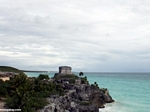
There are bus services to the coastal ruins of Tulum (2 hrs, 60 pesos), which are literally on the water, well excavated, and framed by powder white beaches.
The large ruins of Chichen Itza are often visited on a day trip from Cancun, but are rather distant and only a small portion of the site and attractions can be seen this way. If you find the ancient Maya of interest, spend a night at one of the hotels at Chichen so you needn't have a rushed incomplete visit.
The ruins of Tulum are another relatively nearby extraction. They are similar to Chichen Itza but are built beside a beautiful beach. Unlike Chichen Itza, you are not allowed to go inside or climb on the pyramids. Of the two sites, most people tend to prefer Chichen Itza.
Distant places include Palenque (14hrs approx, 450 pesos) and San Cristobal de las Casas (a nasty 17hrs, 500 pesos, well worth the journey); these are better visited using somewhere else much closer as a base.
Articles involving tourism in Mexico:
SHARE:
|
|
|