|
|
|
|
Photos of the Yucatan, Mexico
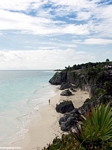
Below are links to pictures from the Mexican Yucatan. caribbean | reefs | cenotes biotopes | cenotes caves | lagoon | tulum | cancun region
Except where noted, all images are the property of Rhett A. Butler, copyright 1994-2004. Contact me with questions regarding use, reproduction, or purchase of any of the pictures.
Rapid growth
The 80-mile stretch of coastline south of Cancun on the Yucatan Peninsula of Mexico -- now called the Riviera Maya -- has undergone a remarkable transformation over the past decade, becoming Mexico's fastest-growing resort area. Places like Playa de Carmen and Tulum have gone from small towns to booming resort developments as developers bypass bureaucratic approvals to buy and build up beachfront lands as fast as possible. Mangrove swamps, which are largely responsible for the region's sparkling clear waters and biologically rich coral reefs, are the primary victims of land clearing for hotels and condominiums.
High profitability
According to a study mentioned in the Wall Street Journal, an 800-room hotel on the Riviera Maya can be built for "about $60 million, compared with about $100 million in Cancun. Because of cheap labor, operational costs come to about $18 per person per day, while the average room tariff is $125 per person per day. Assuming a 90% occupancy rate -- slightly higher than the current 86% norm on the coast -- annual net profits could amount to around $15 million. That rate of return would allow the developers to recover their investment within four years, very fast by industry standards."
Backlash
The tide may be shifting as resentment towards unchecked development grows. In the past couple of years authorities have shut down construction on two hotels that threatened a sea turtle nesting beach at X'cacel and illegally cleared mangrove swamp for building an access road. Environmentalists and local authorities have increasingly turned toward the National Fund for Tourism Development (Fonatur), the agency that built Cancun, to help manage development in the region.
Source:
The Wall Street Journal
Fast Tourism Growth, Hotel Boom Threaten Balance in the Yucatan
By JONATHAN FRIEDLAND
August 20, 1999
Recommended travel guides on Mexico:
News on Mexico
Declaration calls for more wilderness protected areas to combat global warming
(11/11/2009)
Meeting this week in Merida, Mexico, the 9th World Wilderness Congress (WILD9) has released a declaration that calls for increasing wilderness protections in an effort to mitigate climate change. The declaration, which is signed by a number of influential organizations, argues that wilderness areas—both terrestrial and marine—act as carbon sinks, while preserving biodiversity and vital ecosystem services.
New species of ghostshark discovered off California's coast
(09/22/2009)
The discovery of Eastern Pacific black ghostshark Hydrolagus melanophasma is notable for a number of reasons. It is the first new species of cartilaginous fish—i.e fish whose skeletons are made entirely of cartilage, such as sharks, rays, and skate—to be described in California water since 1947. It is also a representative of an ancient and little-known group of fish.
Conservation of Mexico's ungulate species explored
(05/25/2009)
Nearly one third of the New World's 32 species of ungulates are found in Mexico, which serves as an important biological transition zone between temperate North America and tropical Central and South America. While few of these species are at risk of extinction, their ecological and economic importance makes them a significant conservation concern. As such, a special issue of Tropical Conservation Science, mongabay.com's open access journal, takes a closer look at Mexico's ungulates.
Mexican Salamanders Used in Neurology Labs May Go Extinct in Wild
(04/21/2009)
Ambystoma mexicanum, a salamander found only in the fetid canals surrounding Mexico City, faces extinction despite the efforts of researchers. As reported by Robert Koenig in the 5 December issue of Science, ecologists estimate that there are now only 100 of these salamanders per square kilometer in the canals, swamps, and lakes around the city – a rapid drop from their density of 600 per square kilometer in the 1980s. The population has dwindled as the system of waterways has dried up and become more polluted, and the salamander is now designated as critically endangered by the International Union for the Conservation of Nature (IUCN). Luis Zambrano of the National Autonomous University of Mexico is studying the axolotl to better understand its ecology, reproduction, and conservation. He’s working to identify the best areas of habitat and establish reserves.
Wild jaguar outfitted with radio-collar in U.S. for first time
(02/20/2009)
The Department of Fish and Game in Arizona captured a jaguar south Of Tucson, Arizona and fitted it with a GPS radio collar. The jaguar, a well-documented male named ‘Macho’, is the first in the US to be fitted with such a collar, providing frequent updates on its movements.
Jaguar photographed for the first time in Central Mexico
(02/11/2009)
As a result of a research effort by the Autonomous University of the State of Mexico (UAEM) and the University of Alicante (UA), scientists have for the first time photographed a wild jaguar in central Mexico. The sighting has significant conservation implications, showing that the big cat still occurs in central Mexico despite persecution by hunters, habitat destruction, and depletion of prey.
Salamander populations collapse in Central America
(02/09/2009)
Salamanders in Central America — like frogs, toads, and other amphibians at sites around the world — are rapidly and mysteriously declining, report researchers writing in the journal Proceedings of the National Academy of Sciences. Disturbingly, salamanders are disappearing from protected areas and otherwise pristine habitats.
Chocolate has been a delicacy north of Mexico for a thousand years
(02/02/2009)
Chocolate, produced from cacao beans, has been a part of American culture for a thousand years according to new paper published in the Proceedings of the National Academy of Sciences. Analyzing chemical residue from jars of native peoples in New Mexico, researchers Patricia Crown and Jeffrey Hurst discovered theobromine, a chemical signature of cacao. The jars have been dated from 1000 to 1125 AD, well over three hundred years before Columbus and the earliest recorded discovery of cacao north of Mexico. The cacao jars are from Pueblo Bonito, an archaeological site in Chaco Canyon, which is located in northwestern New Mexico. Chaco Canyon, once home to 2,000-5,000 inhabitants, was composed of a dense group of pueblos, of which Bonito was the largest. Incorporating 800 rooms, Pueblo Bonito was the center of a number of towns and villages in Chaco Canyon.
Shade-grown coffee preserves native tree diversity
(12/23/2008)
A new study finds that shade-grown coffee protects the biodiversity of tree species, as well as those of birds and bats. Published in Current Biology, the study found that native trees in shade-grown coffee plantations aid the overall species’ gene flow and can become a focal point for reforestation.
U.S., Mexico, Canada pledge to save the vaquita from extinction
(10/30/2008)
The United States, Mexico, and Canada will work together to conserve the vaquita, the world's smallest, and most endangered, species of cetacean.
Thousands of endangered sea turtles killed as fishing bycatch in Mexico
(10/15/2008)
Thousands of endangered loggerhead sea turtles are being killed as bycatch in the Mexican fishing industry, reports a new study published in the journal Endangered Species Research.
The extinction of the baiji a 'wake-up call' to conserve vaquita and other cetaceans
(08/25/2008)
In December of 2006 an expedition spent six weeks surveying the Yangtze River in China for one of the world's rarest cetaceans, the baiji. Also known as 'The Goddess of the Yangtze' the shy river-dolphin had roamed the river for millions of years locating fish with echolocation. The survey came back empty-handed without a spotting a single dolphin. Dr. Jay Barlow, a member of the surveying team, described his emotions on the expedition's findings in an interview with Mongabay.com: "I was stunned. I knew the species was in trouble, but I did not think they were already gone. We really had not seen the extinction of a large mammal species in 50 years, so we grew complacent."
14 countries win REDD funding to protect tropical forests
(07/24/2008)
Fourteen countries have been selected by the World Bank to receive funds for conserving their tropical forests under an innovative carbon finance scheme.
Mangroves are key to healthy fisheries, finds study
(07/21/2008)
Mangroves serve as a critical nursery for young marine life and therefore play an important role in the health of fisheries and the economic well-being of fishermen, report researchers writing in the early online edition of the Proceedings of the National Academy of Sciences.
Mexican canyon serves as key refuge for endangered spider monkeys
(06/09/2008)
A picturesque canyon in Chiapas, Mexico is serving as an important refuge for the northernmost population of Spider monkeys, reports a study published in the June issue of Tropical conservation Science.
Ocean acidification worse than expected, threatens sea life
(05/22/2008)
Increasing ocean acidification along the continental shelf of North America will likely have negative impacts on marine ecosystems, including the corrosion of calcium carbonate exoskeletons in many organisms, warn researchers writing in the journal Science.
Defaunation, like deforestation, threatens global biodiversity
(05/20/2008)
Loss of wildlife is a subtle but growing threat to tropical forests, says a leading plant ecologist from Stanford University. Speaking in an interview with mongabay.com, Dr. Rodolfo Dirzo says that the disappearance of wildlife due to overexploitation, fragmentation, and habitat degradation is causing ecological changes in some of the world's most biodiverse tropical forests. He ranks defaunation — as he terms the ongoing biological impoverishment of forests — as one of the world's most significant global changes, on par with environmental changes like global warming, deforestation, and shifts in the nitrogen cycle.
Bats protect crops from insects
(04/04/2008)
Bats eat as many insects at night as birds do during the day, according to research published in the journal Science.
Bats eat as many insects as birds
(04/03/2008)
Bats eat as many insects at night as birds do during the day, according to research published in the journal Science.
Monarch butterfly migration threatened by illegal logging in Mexico
(04/02/2008)
Destruction of forests in central Mexico, is putting the Monarch butterfly's annual migration at risk, says a researcher from the University of Kansas.
Fragmentation puts Mexican howlers at risk
(03/03/2008)
Forest fragmentation is putting mantled howler monkeys in southern Mexico at risk, reports a new study, published in the inaugural issue of the open access e-journal Tropical conservation Science.
Rainforest fragmentation affects reptiles and amphibians
(02/20/2008)
Deforestation of tropical ecosystems is one of the major threats to biological diversity. Anthropogenic activities transform tropical environments into semi-natural landscapes generating a great amount of forest edge that limits with pastures and agricultural lands.
Two strange carnivorous dinosaurs discovered in the Sahara
(02/12/2008)
Two previously unknown species of dinosaur discovered in the Sahara were unusual meat-eaters, report scientists from the University of Chicago and the University of Bristol.
New duck-billed dinosaur discovered in Mexico
(02/12/2008)
A previously unknown species of dinosaur has been discovered in Mexico, shadding new light on the history of western North America, report researchers from the Utah Museum of Natural History at the University of Utah.
Photo: Mexico's Popocatepetl volcano erupts
(12/03/2007)
Mexico's Popocatepetl volcano erupted several times on Saturday, December 1, ejecting steam and ash, according to Mexico's National Disaster Prevention Center (CENAPRED).
Photo of the Venomous Gila Monster Getting an X-ray
(11/28/2007)
Dr. Tim Georoff, a veterinarian for the Wildlife conservation Society's Bronx Zoo, handles this venomous lizard with great care as he prepares this female for an radiograph (X-ray).
Only 150 vaquita remain
(11/19/2007)
Only 150 individual vaquita, the world's smallest cetacean, remain, according to a new study published in conservation Biology. The species has been decimated as accidental bycatch in fishing nets in its Gulf of California habitat. Researchers--who say there may be only a two-year window to save the species from extinction--have launched a last-ditch conservation effort.
Mexican fishing villages work to change practices to preserve loggerhead turtles
(10/17/2007)
Industrial fishing operations take plenty of blame for both depleting fish stocks and inadvertently catching innocent bystanders such as dolphins, sharks, seabirds, and sea turtles--a phenomenon known as "bycatch.".
Dean was 3rd most intense Atlantic hurricane at landfall
(08/21/2007)
Hurricane Dean was the third most intense Atlantic hurricane to make landfall, according to forecasters at the National Hurricane Center who measured the storm's central atmospheric pressure.
Crop domestication originated in compost piles
(08/19/2007)
New research lends support to the theory that backyard gardens and refuse heaps played an important role in early crop domestication.
Cancun [Wikipedia]:
Cancún is a coastal city in Mexico's easternmost state, Quintana Roo. It is the municipal seat of Benito Juárez municipality and a world renowned tourist resort.
Geography
The average temperature in Cancún is 27° C (80° F) with more than 240 days of sunshine, and rain is rare. The beaches are almost 100 percent limestone; the porous quality of the limestone makes for cool sand even under the intense tropical sun. Cancún is divided into two parts: The narrow 23-kilometer-long (14-mile) island section (Cancún Island) is lined with modern beachfront hotels surrounded by the Bahía de Mujeres (Bay of Women), the Caribbean Sea, and the Nichupte and Bojorquez lagoons. The mainland downtown commercial section (Cancún City), connected to the island by two bridges, has broad avenues lined with whitewashed shops, restaurants, and hotels.
History
In the early 1950s Cancún was an almost unpopulated and undeveloped island just off the Caribbean Sea coast of the Yucatán peninsula, home to three caretakers of a coconut plantation and small Pre-Columbian ruins of the Maya civilization. The government of Mexico decided to develop a tourist resort on Cancún which was originally financed by a USD $27 million loan from the International Development Bank. A causeway was built to link Cancún to the mainland, and an international airport was built, along with what was at first a model city for workers, complete with housing, schools and medical facilities. On the opposite side of the island from the Caribbean Sea is Nichupte Lagoon, which is used for boat and snorkelling tours of the area.
Development of Cancún started in 1970 and grew rapidly in the 1980s. Unfortunately, the original very sensible master plan was repeatedly modified and, on the mainland, often ignored. According to long-time resident Jules Siegel (author of the "Cancun User's Guide" and translator of Fernando Martí's "Cancun, Fantasy of Bankers"), municipal authorities have struggled to provide public services for the constant influx of people, as well as to control squatters and irregular developments, which now occupy an estimated ten to fifteen percent of the mainland area on the fringes of the city, he says.
Despite initial skepticism that forced the Mexican government to finance the first eight hotels, Cancun soon attracted investors from all over the world, but approximately 70% of the Hotel Zone properties are owned by Mexicans, many of them local residents, Siegel says. The figure is close to 100% for the mainland. Some observers believe that the resort is foreign-owned because they are confused by the hotel operating companies, which are international companies that supply administration and marketing services. They do not usually own the hotels themselves. Even outlets of restaurant chains such as McDonald's and Domino's Pizza are Mexican-owned.
The city has grown rapidly over the past thirty years to become a city of approximately half a million residents, covering the former island and the nearby mainland. There are actually very few true 'cancunenses' (people originally from Cancún) because of the rate at which the resort and its service areas grew. Most people living here are from mainland Mexico and a growing number are from the rest of America and Europe.
Environmental concerns
Although some environmentalists claim that Cancún is an environmental disaster, Siegel says that is not true. There has obviously been environmental damage and the situation could deteriorate rapidly, he reports, but at present (February 2005) Cancún's main problem is a breakdown of garbage collection and disposal as a result of political conflicts that will hopefully be solved by a new administration elected February 6, 2005. Sewage treatment is another danger point, he says. Although approximately 75% of the city has public sewer lines, many homes rely on septic tanks. The underground water table is beginning to show symptoms of contamination, but by the standards of most populated areas in the United States the water is still relatively clean.
"You can see the bottom of the Caribbean off Cancún in satellite photographs," Siegel says. He discusses this and other issues at length on his website, http://www.cafecancun.com.
Tourism in Cancún
In Cancún there are about 140 hotels with 24,000 rooms and 380 restaurants. Three million visitors arrive each year in an average of 190 flights daily. The hotel zone is one of the most exclusive internationally, with upmarket restaurants, bars, and the like which have catered for quite a number of the rich and famous. The hotel zone tends to be rather expensive as it is aimed at visitors and relies on the all inclusive hotels to keep them all in this area allowing prices to soar. Downtown is home to less expensive places to shop like Walmart, Comercial Mexicana and Soriana, not to mention several flea markets like the one in the hotel zone.
Downtown Cancún gives us a different aspect. There are also many clubs for all types of people, including gay clubs like Karamba or Glow, but the hotels are more accessible to all types of travelers, including some with lower rates. International brands in Downtown area are Radisson Hacienda Cancun, Best Western Plaza Caribe, Oasis America.
The temperature of the city is warm, moderated by the marine breeze which circulates through its avenues. The temperatures are typically between 26°C and 36°C (78.8°F and 96.8°F).
Cancún's hotel zone also has an interactive aquarium where visitors can see the marine diversity of the area, swim with dolphins and feed sharks. Here and there in the hotel zone are some ancient ruins.
The main language in Cancún is Spanish, although English is widely spoken throughout the tourist areas. Mayan dialects are also spoken between some workers and people born in the Yucatán peninsula.
Cancún is served by Cancún International Airport.
Cancun [Wikitravel]:
Cancun (Spanish: Cancún) is a planned tourist city on Mexico's Yucatan Peninsula. It is a popular vacation spot on the Caribbean coast. There is much to do in the city, and if you're willing to take an hour or two bus trip, there is more to explore than you could possibly fit into a single vacation.
One word of warning, late June is especially hot, so come prepared or try the off season.
Understand
Cancun itself was built on a site selected by computer (yes, really) as the ideal spot for a new tourist development by the Mexican government. The state of Quintana Roo was still a territory and this area had few inhabitants when Cancun was built. Cancun and the surrounding area is almost entirely built around the tourist industry. It abounds with overpriced all-inclusive resort hotels.
Stay here if you wish to spend your vacation with other tourists and minimize your contact with any of the Yucatan's local culture.
Those mostly seeking beach, scuba, or diving who are a bit adventurous can easily find rooms on equally beautiful and less crowded beaches somewhere and hour or two drive south along the coast for 1/10th the cost of major Cancun hotels. Some Spanish language skills may aid in finding better deals. You can rent a car, or take the bus to Puerto Morelos (about 20 minutes) or Tulum (1 hour). Playa del Carmen (45 minutes, MXN$65) is between the two, but caters to the all-inclusive crowd. Taxis are also available.
Those looking for a base of operations who want good or luxury hotels and the advantages of urban life but prefer more local flavor may wish to stay in the Yucatan's main city of Mérida; many international flights in to Cancun continue on after a stop to Mérida's international airport.
Do
The Ocean and Beaches. For the more advanced swimmers, the edge of the open ocean can make for a challenging and fun swimming experience. For less advanced swimmers, or those with little ones, pick a resort facing into the bay for a gentle and relaxing aquatic experience. The sand found here is ground up coral and doesn't get hot like you might expect.
Buy
The markets. Bring your haggling skills and get ready for a vast shopping experience in any of the city markets. Great buys can be found, but you need the nerve to get the price right.
Get out
The best feature of the city is undoubtedly its transport links, with extremely cheap charter flight deals available to the UK (from around £100) and elsewhere, including the USA and Cuba.
Beware leaving Mexico without enough money. The Mexican Government charges a travel tax of around 500 pesos/50 US Dollars to actually leave the country.
Trips from Cancun
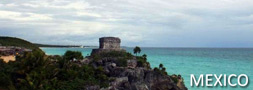
There are bus services to the coastal ruins of Tulum (2 hrs, 60 pesos), which are literally on the water, well excavated, and framed by powder white beaches.
The large ruins of Chichen Itza are often visited on a day trip from Cancun, but are rather distant and only a small portion of the site and attractions can be seen this way. If you find the ancient Maya of interest, spend a night at one of the hotels at Chichen so you needn't have a rushed incomplete visit.
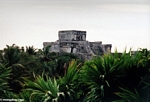
The ruins of Tulum are another relatively nearby extraction. They are similar to Chichen Itza but are built beside a beautiful beach. Unlike Chichen Itza, you are not allowed to go inside or climb on the pyramids. Of the two sites, most people tend to prefer Chichen Itza.
Distant places include Palenque (14hrs approx, 450 pesos) and San Cristobal de las Casas (a nasty 17hrs, 500 pesos, well worth the journey); these are better visited using somewhere else much closer as a base.
Articles involving tourism in Mexico:
|