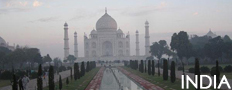
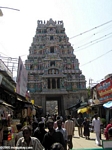
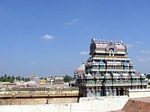
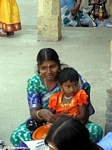
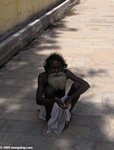
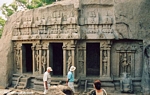
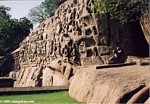
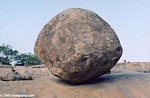
Pictures of India 2005
These photographs were taken by Nancy Butler and are the property of mongabay.com, copyright 2005. Contact me with questions regarding use, reproduction, or purchase of any of the pictures.
Index | Page 2 | Palaces | Kama Sutra Carvings | Places | Other India Photos
Recommended travel guides on India:


India [Wikitravel]:
India is the largest country on the Indian Subcontinent in the south of Asia. It is geographically a large country, with significant cultural and linguistic diversity. It is a popular country among travellers.
Regions
- The North -- the country's capital, the Taj Mahal, The Ganges, Holy cities like Varanasi, Ayodhya, Mathura, Haridwar, Hrishikesh and beautiful Himalayan mountains
- The West -- deserts and beautiful cities like Jaipur, Udaipur, Bikaner, Goa, vibrant and biggest Indian city "Mumbai" (previously known as Bombay), wonderful beaches and '"Bollywood"(Indian film industry in Mumbai)
- The South -- colorful Hindu temples, tropical forests, Backwaters of Kerala, Beaches and Ghats of Karnataka and islands
- The East -- India's mostly rural region, its largest city "Kolkata" (previously known as Calcutta), the holiest river "The Ganges", the temple cities of Puri of Lord Jagannath fame and Bhubaneswar, both in Orissa.
- The North-East -- remote and sensitive, the country's tribal corner, with beautiful landscapes and famous for "Tea Gardens".
Cities
India has many large and famous cities. Below is a list of the most well-known. Other cities are listed under their specific regional section.
- New Delhi, the Capital of Ancient Bharat (then called "Indraprastha") and Modern India - The political capital of India
- Agra - Home of the Taj Mahal
- Bangalore - The Garden City, Pub City, Silicon Valley of India, Land of Silk, Gold, Sandal Wood, Incense etc.
- Bombay (Mumbai) - The financial capital of India, "Bollywood"(Indian Film Industry's hub)
- Chennai (Madras) - City of Temples, Home of famous Marina Beach, Automobile Capital of India
- Coimbatore - Manchester of South India
- Hyderabad - Pearl city of India, and part of the Silicon Plateau with Bangalore
- Kochi (Cochin) - The Queen of the Arabian Sea
- Kolkata (Calcutta) - Known as City of Joy.
- Mysore - Twin city of Bangalore. Famous for the Royal Palace, Brindavan Gardens.
- Pune - Pune is located in the Western India and is Maharashtra's cultural capital.
- Shimla - The summer capital of former British India is a small jewel in the lush Himalayan foothills.
- Srinagar - Famous for Dal lake, located in the picturesque Himalayas
- Varanasi - A sacred Hindu city located on the banks of the Ganges.
Other destinations
- National reserves, sanctuaries Thekkady, Muthumala, Yercaud, Kumarakom
- Hill resorts Ooty, Kodaikanal, Munnar, Gulmarg, Sonamarg, Ladakh, Leh, Kufri, Auli, Narkanda, Kullu, Manali, Dharamsala, Dalhousie, Lahaul, Spiti, Sarahan, Nainital, Mussoorie, Rishikesh, Char Dham, Kumaon, Garhwal, Gangtok, Darjeeling, Zanskar, Sivakasi
- Beaches Kovalam, Beaches in Goa, Andaman Islands
Sacred sites
As the birth place of several world religions, India is home to many sacred and holy sites:
- Ajanta Caves, Maharashtra State - a complex of caves representing some of the best of early Buddhist art.
- Bodh Gaya, Bihar State - the place where the Buddha Shakyamuni attained enlightenment.
- Ellora Caves, Maharashtra State - a complex of caves representing Buddhism, Brahmanism and Jainism.
- Kushinagar, Uttar Pradesh - the site of the Buddha Shakyamuni's death.
- Manthralayam, Andhra Pradesh - Sri Guru Ragavendhra Temple
- Nalanda, Bihar State - Site of an early Buddhist University/monastic center
- Sanchi, Madhaya Pradesh is the site of a great Buddhist stupa.
- Sarnath, near Varanasi, Uttar Pradesh - the site of the deer park where the Buddha Shakyamuni first taught the Buddha Dharma.
- Tirupati and Tirumala, Andhra Pradesh - Kaliyuga Vaikuntam, abode of Lord Sri Venkateswara
Understand
India mixes ancient civilizations, fascinating religions, 22 official languages and over 200 other languages and dialects, monuments and cultures with modern technology, economy, and media. India and its neighbours, though not including China and Myanmar, are referred to as the Indian Sub-Continent because of the wide diversity in geography, culture, language and ethnicity.
History
The first known urban society in India was the Indus Valley Civilization, also called the Harappan civilization, which thrived between 2800 BCE and 1800 BCE. One version goes that Aryan tribes from the northwest invaded about 1500 B.C.; their merger with the earlier inhabitants created the classical Indian culture. Others belive that the Vedic culture may have originated in India or from the Indus Valley Civilization. Whether the Vedic peoples originated in India or invaded India from the northwest, and their relation to the Indus Valley Civilisation, are the subject of a considerable debate. Hinduism, the main religion in India, is still followed today in India and worldwide by millions of Hindus.
Arab incursions starting in the 8th century and Turkish in 12th were followed by European traders beginning in the late 16th century. By the 19th century, Britain had assumed political control of virtually all Indian lands. Nonviolent resistance to British colonialism under Mohandas Gandhi and Jawaharlal Nehru led to independence in 1947.
The subcontinent was divided into the secular state of India and the smaller Muslim state of Pakistan. A third war between the two countries in 1971 resulted in East Pakistan becoming the separate nation of Bangladesh. Fundamental concerns in India include the ongoing dispute with Pakistan over Kashmir, massive overpopulation, corrupt bureaucracy, environmental degradation, extensive poverty, as well as ethnic and religious strife. Still, Indians are justly proud of their country's status as the world's largest democracy, and there have recently been impressive gains in economic investment and output.
Geography
India is the seventh largest country in the world in terms of surface area, covering an area in South Asia approximately one-third the size of the United States. India is the second most populous country in the world and along with neighboring China is only one of two countries to harbor a population exceeding one billion people as of 2004. Almost one-sixths of all people alive today live in India.
India along with its smaller neighbors including Pakistan, Bangladesh, Nepal, and Sri Lanka (all but Nepal were originally part of British colonial India) occupies the lion's share of South Asia and is often called the Indian Subcontinent or simply the Subcontinent. India's vast size allows for an enormous diversity of everything: landscapes, people, languages , and cultures. While Northern India is part of the Asian mainland, the country's Southern half is an enormous triangular peninsula --one of the largest in the world-- tapering away to a Southernmost point, Cape Comorin, in the Indian Ocean only 8 degrees North of the Equator.
Geographically, the Indian Subcontinent is bound by the Himalayas to the North and Northeast, the Great Indian desert in the northwest, and two broad coasts, the Arabian Sea to the west, and the Bay of Bengal to the east. Both have tropical or temperate beaches with various levels of development. India's beaches can be exceedingly beautiful lush affairs with golden sands, warm seas, and palm fringed coves, but there are no large expanses of crystalline clear waters such as those found in the Caribbean or Gulf of Thailand. The reason being the large number of Indian rivers flowing into the waters around the peninsula which bring down turbid sediment from the Himalayas in the North.
To the north, India is separated from Tibet by the world's highest mountain range, the Himalayas. Parts of Northern India bordering Chinese occupied Tibet, such as the spectacular Ladakh region in the Northernmost Indian state of Jammu & Kashmir, are essentially the only remaining enclaves where Tibetan-Buddhist culture has flourished unchanged since the Chinese takeover of Tibet proper. This, along with the Dalai Lama's position as a high profile Tibetan exile in India has led to much interest in India's Tibetan-Buddhist community, even as Lhasa continues to decay under decades of administration by Beijing. The landlocked Himalayan kingdoms of Nepal and Bhutan sandwiched between China and India, are the country's other Northern neighbors. To the northwest is a long and tumultuous border with Pakistan that extends from the Karakoram range to the Arabian Sea; the northeast of the country wraps around Bangladesh and borders on Myanmar.
Although India is often associated with jungles -- and there are jungles here, of course -- the tropics share the sub-continent with a temperate zone in the north, deserts in the northwest, and the alpine regions of the Himalayas.
Culture
India has a rich diversity of culture and tradition. It's probably the only country where people of so many different origins, religious beliefs, languages and ethnic background coexist. Due to this rich diversity the number of festivals that are celebrated in different parts of the country varies. There are holidays that coincide with these festivals. In addition to these there are national holidays which are applicable across the country. Here is a list of national holidays. For regional holidays look under the particular state.
continued
Articles involving tourism in India:
SHARE:
|
|
|