|
|
|
|
Roatan, Honduras Photos
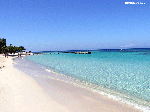
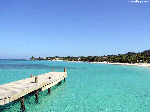
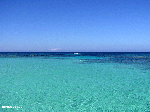
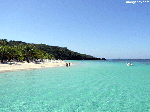
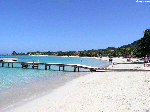
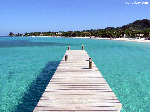
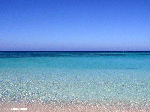
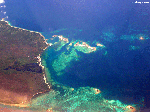
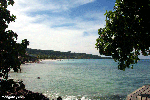
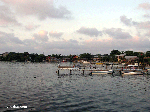
Roatan Island is the largest of Honduras' Bay Islands -- measuring roughly 29 miles long and 4 miles wide. Roatan is best known for its fantastic reefs which make it one of the best snokeling and diving destinations in the Caribbean. The island features white sand beaches [West Bay], mangrove forests, and a thriving dive community.
Recommended travel guides on Honduras:
Roatán [Wikipedia]:
Roatán, located between the islands of Utila and Guanaja, is the largest of Honduras' Bay Islands. It is approximately 60 kilometres long, and less than 8 kilometres wide at its widest point.
The capital and most populated town is Coxen Hole, located in the Southwest of the island. Other important towns include French Harbor and Oak Ridge.
Located near the largest barrier reef in the Caribbean Sea (second largest worldwide after Australia's Great Barrier Reef), it has become an important cruising and diving destination in Honduras. Tourism is its most important economic sector, though fishing is also an important source of income for islanders.
In 1998, the island suffered considerable damage from Hurricane Mitch, temporarily paralyzing most commercial activity.
Tourism and environmental impact
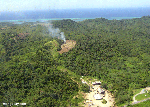
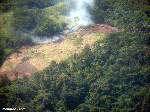
While tourism has strongly contributed towards the economic development of the island, it has also altered Roatan's fragile ecosystem. Land clearing for the construction of residential complexes, as well as improper sewage and garbage disposal methods, have inflicted considerable damage to the island in a time span of less than a decade.
Several efforts by environmental organizations have helped to reduce the adverse environmental impacts. Still, the long-term success of these efforts is uncertain because the inflow of tourism is likely to increase with the completion of a new international airport in the neighboring island of Utila.
Language
Although Spanish is spoken in mainland Honduras, the main language on the island is (creole) English,
Conservation news from Honduras:
Felix Death Toll Washes Up on Coastline
(09/07/2007)
Nicaraguan and Honduran officials have announced that upwards of 100 people are confirmed dead, and another 120 still unaccounted for after Hurricane Felix made landfall earlier this week.
Forest fires burn in Central America
(04/10/2006)
Hundreds of fires are burning across Central America according to NASA satellite images and reports from the ground. Fires have been detected in Mexico, Guatemala, El Salvador, Honduras, and Nicaragua.
Illegal timber from Honduras reaching the United States
(11/04/2005)
U.S. companies are unknowingly importing illegal Honduran wood, contributing to deforestation, corruption and poverty in the Latin American country, according to a yearlong undercover investigation by the Center for International Policy and the Environmental Investigation Agency (EIA).
Honduras wins aid pact tied to human rights, anti-corruption efforts
(07/10/2005)
Last month Honduras became to second country to receive aid under the controlversial Millennium Challenge Account program when it signed a five-year $215 million funding deal. The Millennium Challenge Account gives grants to countries committed to respecting the rule of law and reducing corruption.
Honduran priest recognized as environmental hero with $125,000 award
(04/22/2005)
On April 18th, 2005, Father José Andrés Tamayo Cortez was awarded the prestigious Goldman Environmental Prize. The Prize recognizes individuals for sustained and significant efforts to preserve and enhance the natural environment, often at great personal risk. Each winner receives an award of $125,000, the largest of its kind.
The Next Costa Rica? Environmental activism takes root in Honduras
(04/18/2005)
With its biodiversity, rich history, beautiful beaches, and stunning reefs, some believe Honduras could be the ecotourism hotspot in Central America. However, between growing gang violence linked to the drug trade in the United States and conflicts between developers and local communities, the country still faces many challenges in becoming the next Costa Rica. Special correspondent Tina Butler takes a look at changing attitudes about the environment in one of Central America's poorest countries.
|