Honduras Photos
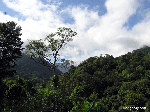
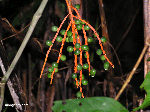
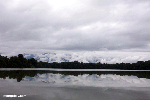
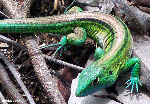
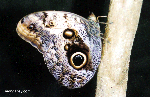
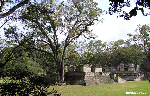
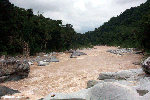
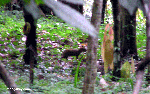
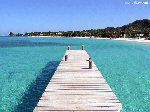
In 2004 I visited Honduras and Panama. In Honduras I spent time in Copan seeing Mayan ruins, Pico Bonito shivering in the rain while seeing some rainforest wildlife and beautiful rivers, and Roatan enjoying the spectacular coral.
Rainforest report for Honduras - from the late 1990s
Library of Congress: Honduras
Environmental activism takes root in Honduras
Recommended travel guides on Honduras:

Honduras [Wikipedia]:
Honduras is a independent country in northern Central America, bordered to the west by Guatemala, to the south west El Salvador, to the south east by Nicaragua, to the south by the Pacific Ocean, to the north by the Gulf of Honduras and the Caribbean Sea. Belize (formerly "British Honduras") is 75 km away across the Bay of Honduras.
History
The Pre-Columbian city of Cop�n is a locale in extreme western Honduras, in the Cop�n Department, near to the Guatemalan border. It is the site of a major Maya kingdom of the Classic era. The ancient kingdom, named Xukpi (Corner-Bundle), flourished from the 5th century AD to the early 9th century, with antecedents going back to at least the 2nd century AD. The Maya civilization decayed, and by the time the Spanish came to Honduras, the once great city-state of Cop�n was overrun by the jungle.
After the Spanish discovery and subsequent conquest, Honduras became part of Spain's vast empire in the New World. The Spanish ruled Honduras for approximately 3 centuries.
Honduras became a state in the United Provinces of Central America in 1821, and an independent republic with the demise of the union in 1840.
The Football War of 1969 was fought with El Salvador.
After two and a half decades of mostly military rule, a freely elected civilian government came to power in 1982. During the 1980s, Honduras was used by anti-Sandinista contras fighting the Nicaraguan government and an ally to Salvadoran government forces fighting against leftist guerrillas.
Hurricane Mitch devastated the country and wrecked its economy in 1998.
Geography
Honduras borders the Caribbean Sea on the north coast and the Pacific Ocean on the south through the Gulf of Fonseca. The climate varies from tropical in the lowlands to temperate in the mountains. The central and southern regions are relatively less humid than the northern coast.
Honduran terrain consists mainly of mountains (80%), but there are narrow plains along the coasts, a large undeveloped lowland jungle La Mosquita region in the northeast called "The Mosquito Coast", and the heavily populated lowland San Pedro Sula valley in the northwest.
Natural resources include timber, gold, silver, copper, lead, zinc, iron ore, antimony, coal, fish, and hydropower.
Demographics
The population of Honduras is predominantly of Mestizo descent and Roman Catholic faith, but there are also several Evangelical denominations. Along the northern coast are communities of English speakers who have maintained their culture since Honduras was part of the British Empire. Groups of Garifuna live along the north coast. In the 20th century, Garifunas became part of Honduras' identity through theatrical presentations such as Louvavagu. Asians in Honduras are mostly of Chinese and Japanese descent. Citizens of British descent dwell among the Bay Islands, Roatan, and �tila. Hundreds of families can find their roots in Lebanon or Palestine, in Middle Eastern families called "turcos", those Hondurans with economically powerful interests in manufacturing, finance, retail, and food production. Many others have connections to Spanish, the US (especially New Orleans, Florida and California) and the Cayman Islands.
Environment
The Mesoamerican region, the landmass that extends from Southern Mexico to Panama, known for its diversity of species, is often called a "biodiversity hotspot". Similar to other countries in the region, Honduras contains diverse biological resources as well as indigenous cultures. For instance, it is believed that approximately 6,000-8,000 species of vascular plants are distributed across the country. The number of reptiles and amphibians species recorded so far is around 245; birds can be between 650-700 species, and mammal species are close to 110.
In the northeastern region of La Mosquita lies the R�o Pl�tano Biosphere Reserve, a lowland rainforest which provides home to a great diversity of life. Sometimes called "The Last Lungs of Central America", this Reserve was added to the UNESCO World Heritage Sites List in 1982.
TRAVEL
Understand
Honduras is a poor country where tourism is still undeveloped. Good amenities can be found in cities like Tegucigalpa, San Pedro Sula, and La Ceiba but elsewhere conditions can be primitive, especially in the rural areas. Nevertheless a visit is worthwhile, especially to the ancient Maya ruins in Cop�n, the colonial towns of Gracias and Comayagua and the fantastic Caribbean Coast.
Climate
Subtropical in lowlands, temperate in mountains. Natural hazards: extremely susceptible to damaging hurricanes and floods along the Caribbean coast. The small Pacific coast region is susceptible to earthquakes.
Terrain
Mostly mountains in interior, narrow coastal plains. Has only a short Pacific coast but a long Caribbean shoreline, including the virtually uninhabited eastern Mosquito Coast; Natural hazards: Experiences frequent, but generally mild, earthquakes
Get in
By plane
Major international airports with daily flights to Miami and New York are in San Pedro Sula, Tegucigalpa (Toncontin) and Roatan. The main international airlines serving the region are Taca, Copa Airlines and American Airlines. For interior flights check Isle�a, Atlantic and Aerolinas Sosa.
By train
Train infrastructure hasn't been developed in the whole region
By car
From Guatemala, El Salvador, or Nicaragua. The condition of the roads was seriously damaged by the Hurricane Mitch and still hasn't been fully repaired.
By bus
From Guatemala - Tica Bus and Hedmann Alas From Nicaragua - Tica Bus and King Quality From El Salvador - Tica Bus and King Quality
By boat
Boats from Belice come in to the Caribbean ports like Puerto Cortes, but schedules are not regular and cannot be checked through the internet. Cruises to (or that make a stop at) the Bay Islands, however, are somewhat common.
Languages
Spanish, English (Bay Islands), Amerindian dialects (lenca, miskitu, garifuna, among others)
Buy
Handcraft - Honduras is famous by its lenca ceramic
Eat
The Honduran "Plato tipico" is the most famous lunch. It consist of rice, beef meat, fried beans (frijolitos) and fried potato (tajaditas). Delicious to taste.
Another choices are tacos, baleadas and enchiladas, inherited from the neighbour countries.
Drink
National beers: Salvavida, Port Royal, Imperial and the newest Bahia Taste Central American rum Flor de Ca�a (from Nicaragua) Great "licuados" -fruit juices and milk shakes- (mango, pi�a, watermelon, banana, etc.)
Sleep
There is a great variety of places to sleep in the main cities. Check Honduras Tips (see external links) to get updated telephones and rates.
Stay safe
Take special care at night. It is common for a foreigner to be robbed on the streets of Tegucigalpa at night. Thieves will stake out areas in front of tourist hotels, especially the Hotel Maya, in Tegucigalpa. Crime is getting higher, especially in tourist areas. The best tip is not to risk oneself walking through the poor parts of any towns, taking public transport and collaborate with burglars if one is being robbed. Life is not valuable in Central America, so give what you have and don't try to be brave.
Ask local people about which places are safe and which are not, and follow their advice.
Stay healthy
Drink water from bottles or sealed plastic bags. Malaria and dengue can appear at certain locations (poorest places of the country), so ask locals to get informed. Carry a First Aid kit and have contact phone numbers with you. Hepatitis A is very likely unless extreme precautions are taken with regard to water and raw foods. Do not forget ice and brushing your teeth are an easy means of contracting Hepatitis A. It is highly recommended to receive Hepatitis vaccinations prior to travel in Honduras.
Respect
Follow the golden rule by do not be duped by the "culture of need". The Hondurans are very friendly but many are poor and uneducated. Demonstrate grace and respect but maintain your awareness.
Contact
People from Honduras are friendly. English is hardly spoken when leaving the biggest town, so carrying a Spanish dictionary would be a good tip.
Conservation news from Honduras:
|